Year-end: Sino-India relations in the Modi era Editor: Zhang Dan 丨CCTV.com 央视网 12-18-2014 13:30 BJT
By Du Xiaojun, visiting research fellow at Collaborative Innovation Center of South China Sea Studies Partners: historic heritage and practical interests Sino-India relations date back more than 2,000 years, and the vast majority have been characterized by friendly cooperation. Since India gained independence and the People's Republic of China was established, similar experiences have led to understanding between both countries, despite their different political systems. Sino-India relations rapidly developed in the term of the Bharatiya Janata Party's Atal Bihari Vajpayee, the Indian Prime Minister from 1998-2004. And India’s Bharatiya Janata Party, to which Modi belongs, maintains friendly relations with China. 2014 is the "China-India Year of Friendly Exchanges." And bilateral relations have developed well since Modi took office. During Modi's inauguration ceremony in May, Chinese Foreign Minister Wang Yi visited India as a special envoy of President Xi Jinping to consolidate Sino-India relations. In June, Xi and Mohammad Hamid Ansari, Vice President of India, attended the conference marking the 60th anniversary of the Five Principles of Peaceful Coexistence in Beijing. In September, Xi visited India and met Modi in Gujarat State. Both countries signed 12 agreements on nuclear energy cooperation, deepening cooperation on railways and setting up the twin cities between Shanghai and Bombay.
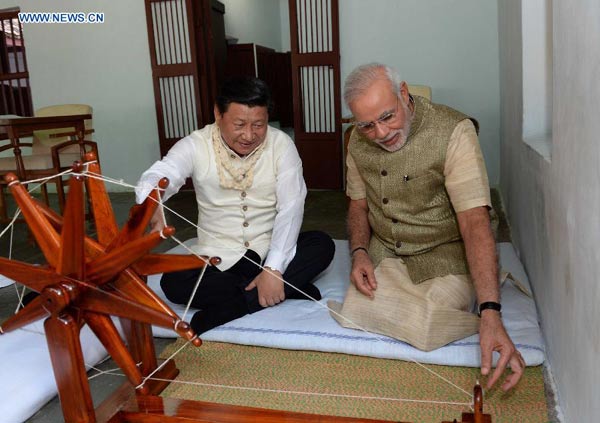
Chinese President Xi Jinping (L) rotates a spinning wheel that was once used by Mahatma Gandhi as he visits Gandhi's former residence along with Indian Prime Minister Narendra Modi (R) in Gujarat, India, Sept. 17, 2014. (Xinhua/Ma Zhancheng) In November, Chinese Premier Li Keqiang met Modi while attending the 25th ASEAN Summit in Nay Pyi Taw, Myanmar. The Modi administration has responded to the good will from China. In Asia, India pays the most attention to China and Japan and delicately balances its relations with the second largest and the third largest economies in the world. At the 6th BRICS Summit in Fortaleza, Brazil, Modi and Xi discussed the future of Sino-India relations. China and India share much common interest, especially in economic trade. The Sino-India trade volume exceeded US$65 billion in 2013, nearly 10 times of that ten years ago. China is India's largest trading partner, and the Sino-India trading volume accounts for 8.5 percent of India's foreign trading volume. Within the next five years, it may reach US$150 billion and Chinese investment to India will likely reach US$20 billion. The mutually beneficial cooperation between China and India is important for maintaining Asia's prosperity and stability.
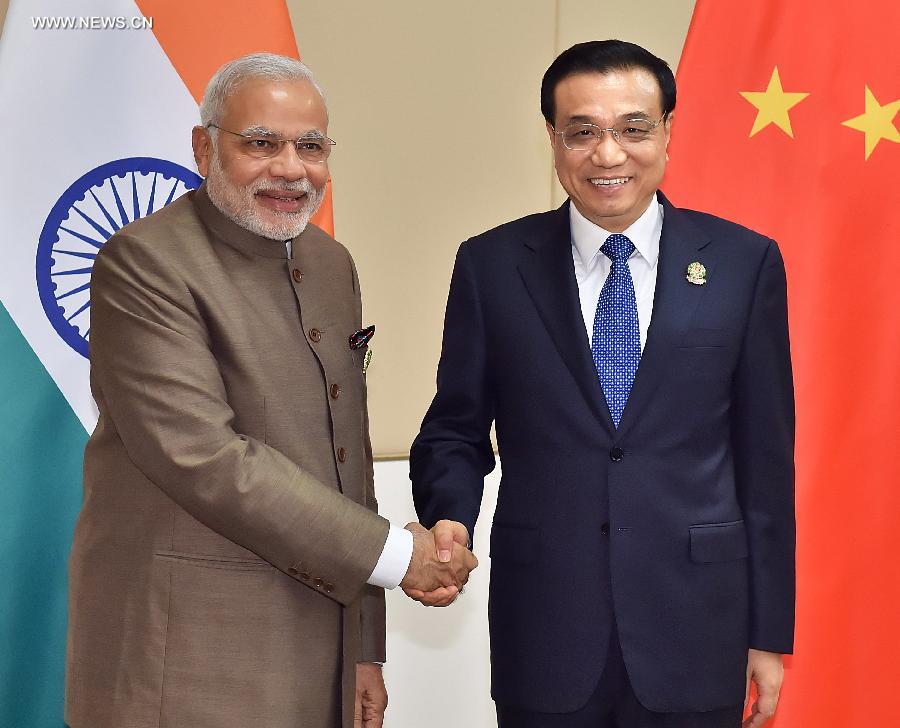
Chinese Premier Li Keqiang (R) meets with Indian Prime Minister Narendra Modi in Nay Pyi Taw, Myanmar, Nov. 13, 2014. (Xinhua/Li Tao) Competitors: Look East Strategy and balance of major powers Although Sino-India relations have developed since Modi assumed office, India is somewhat guarded toward China. While developing ties with China, the Modi administration is also cultivating ties with other powers to maintain a balance among these countries and obtain maximum interests. Modi chose Bhutan as the first destination of his foreign visits. Bhutan is the only country to neighbor China without having established diplomatic ties with it. Bhutan struggling for 1,200 square kilometers of territory with China but is trying to connect with China. The purpose of Modi's visiting Bhutan is to "stabilize" Bhutan and weaken China's influence in South Asia. After Modi’s visit to Bhutan in mid-June, Chinese State Councilor Yang Jiechi and Foreign Minister Wang Yi met with Dorjee Shiren, Foreign Secretary of Bhutan in late-July, to urge Bhutan to demarcate the disputed territory and establish diplomatic ties with China as soon as possible. In the early 1990s, Pamulaparthi Venkata Narasimha Rao, then-Prime Minister of India proposed the "Look East Strategy" for Southeast Asia and East Asia. The relationship between India and the ASEAN has continuously progressed since. India is also devoted to developing its relations with the US, Japan and Australia. Although these multilateral relations do not constitute formal alliances, the targets are very apparent. When Modi visited Japan in late-August, Japan praised India as one of its "most intimate and important" partners, and Abe stressed the importance of Japan-India partnership. Both leaders vowed to increase bilateral cooperation in the fields of economy and security and signed the Tokyo Declaration for Japan-India Special Strategic and Global Partnership. According to the agreement reached during the visit, India will export 2,000 tons of rare earth to Japan every year from February 2015, accounting for 15 percent of Japan's total demand. This may greatly weaken Japan’s dependency on China in importing rare earth. Modi visited the US in late-September. The change of attitude toward Modi demonstrates that the US plans to turn India into an important strategic point of the "re-balance" to the Asia-Pacific region. India may cater to the US to some extent, but will not completely follow the US's agenda. It aims to maintain a balance between China and the US. There have been more frequent interactions between India and Australia. Australian Prime Minister Tony Abbott visited India in early September to sign a memorandum to promote bilateral cooperation in the nuclear energy field. And Modi visited Australia while attending the G20 Summit in mid-November to promote a more intimate strategic partnership between India and Australia. He implicitly mentioned the South China Sea issue and stressed that regional security cooperation is vital for maritime security. Since Modi became Prime Minister, both China and India have expressed good will, and bilateral relations have steadily developed. India plans to play a more important role in regional and international affairs, and the Modi administration has promoted relations with other powers to maintain balance. There is both cooperation and competition between China and India, but there is more cooperation than competition. Both countries can promote mutual trust, bilateral cooperation and common development through harmonious coexistence and mutual learning. |