
The seminar on “China-US Relations after Antony Blinken's visit to China” hosted by the Chahar Center of the City University of Macau was held online on July 22nd. Five experts and scholars on China-US relations discussed in depth the current situation, characteristics and future trends of China-US relations after the visit of Abraham Lincoln.
The seminar was organized by Wang Jianwei, Executive Deputy Director of the Center of the City University of Macau, and was attended by more than 60 participating scholars. They generally believe that, after Blinken’s visit to China, the partial recovery of high-level contacts between the United States and China is unlikely to change the pattern of long-term strategic competition and game between the two country. However, this initiative has played a certain role in stopping the decline of poor China-US relations after Biden taking office. In the short and medium term, it also stabilize the China-US relations to a certain extent.
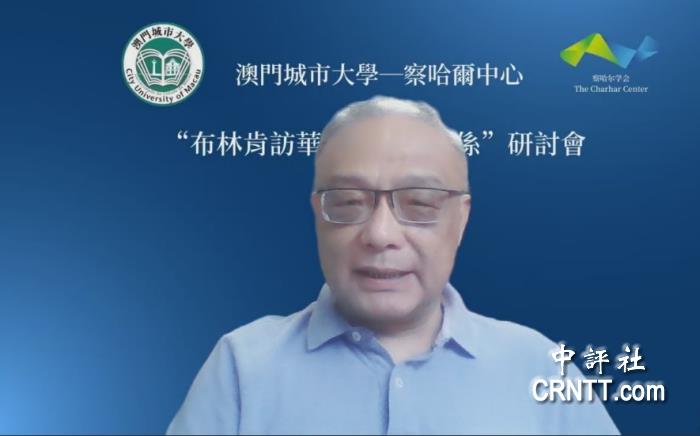
Zhu Feng, Dean of the School of International Studies at Nanjing University and Executive Director of the Collaborative Innovation Center of South China Sea Studies, pointed out that this round of intensive dialogue between China and the U.S. at the top level is more tactical than strategic, and it is still within the overall framework of the Biden government’s policy toward China. The dialogue has only made certain fine-tuning, and does not represent a substantial adjustment or change in U.S. policy toward China. However, the dialogue and contact between China and the United States is still an indispensable diplomatic resource for the stability of China-US relations, which can bring three aspects of that relations: first, it can help understand the political intentions of both sides, reduce miscalculation and misunderstanding; second, ease the highly antagonistic socio-political sentiments of the two sides; third, it is to promote the normalization of people-to-people exchanges between the two sides at the social level.
Wang summarized that scholars reached a broad consensus at the seminar. After Blinken’s visit to China, the limited resumption of high-level exchanges between China and the United States is unlikely to change the pattern of long-term strategic competition and game between China and the United States, but has played a certain role in stopping the decline of poor China-US relations after Biden taking office. In the short and medium term, it also stabilize the China-US relations to a certain extent. Although it is strategically believed that the development of China-US relations cannot go back to the past, in the short and medium term, we cannot give up the efforts to enhance our relations. Not only official-level exchanges should be strengthened, but also social-level ones to enhance mutual trust and reduce miscalculations should be enhanced. Wang Jianwei said that from now to next year’s U.S. election into the substantive stage, China-US relations still have the opportunity to improve. But it is worth thinking about how to make good use of the current favorable conditions in order to stabilize the relationship. In short, the fundamental responsibility for improving China-US relations goes to the US, and China can also seize the initiative to make a shift.(Translate/ Bao Yiwen)