
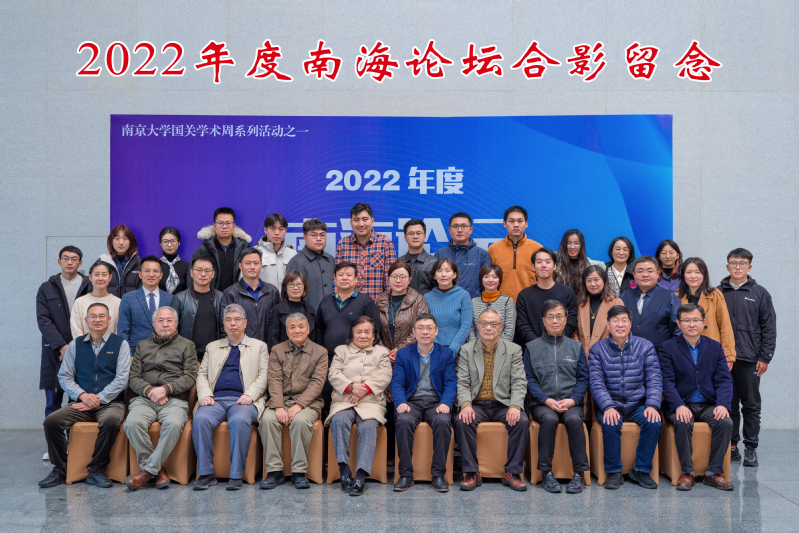
From November 30 to December 1, the 2022 South China Sea Forum, organized by the Collaborative Innovation Center of South China Sea Studies and co-organized by the Editorial Board of Asia-Pacific Security and Maritime Affairs, was held at the International Conference Center of Nanjing University Xianlin Campus. This forum is also one of the activities of the “International Studies Academic Week” organized the School of International Studies of Nanjing University. Nearly 80 experts and scholars from universities and research institutions across China conducted comprehensive and in-depth analyses and discussions on the current situation in the South China Sea. Professor Zhu Feng, Executive Director of the Collaborative Innovation Center of South China Sea Studies and Executive Dean of the School of International Studies of Nanjing University, presided over the conference.
In the opening speech, Professor Lu Yanqing, Vice President of Nanjing University, expressed a warm welcome to the participating experts on behalf of Nanjing University. Lu pointed out that maritime issues are of profound strategic significance in the contemporary era. As a nationally renowned key university, Nanjing University has always attached great importance to the construction of marine-related disciplines and research on related topics. In accordance with the requirements of “building a new type of think tank” and “building the first Nanjing University” proposed by General Secretary Xi Jinping, Nanjing University has made a series of efforts and contributions to the South China Sea issues, policy consultation, public opinion and talent training. It is hoped that this forum will be able to pool the wisdom and opinions of the participants and leave behind insightful perspectives.
In the special lecture session, Professor Wang Ying, Academician of the Chinese Academy of Sciences and Director of the Collaborative Innovation Center of South China Sea Studies, analyzed the physical and geographical characteristics of the South China Sea from the perspective of maritime science, and reviewed the historical development of the islands and reefs and the exploitation of oil and gas in the South China Sea.
Director of the China Society for the Law of the Sea and former judge of the International Tribunal for the Law of the Sea, Gao Zhiguo, reviewed the historical evolution of the nine-dotted line in the South China Sea and elaborated the significance of customary international law and international treaty law of the line in the South China Sea.
Xu Bu, Director of the Chinese Institute of International Studies, indicated from the geopolitical perspective that maintaining the stability of the South China Sea is conducive to the strategic overall situation of the great rejuvenation of the Chinese nation, and that it is important to grasp the long-term and complex nature of the South China Sea issue. China should be committed to strengthening cooperation with ASEAN countries on maritime governance, information sharing and capacity building, as an effort to properly deal with the South China Sea issue.
Liu Wei, Deputy Director of the Bureau of Maritime Rights of the Central Foreign Affairs Office, pointed out that the South China Sea Forum has played an important role in academic exchanges on the South China Sea issue, and that the current research and judgment on the South China Sea issue cannot be separated from the era of the Sino-US game and great power diplomacy. Therefore, China should avoid misjudgment and misunderstanding, strengthen diplomacy and the role of overall planning.
Professor Wu Shicun, Founding Director of the National Institute for South China Sea Studies, analyzed the latest features of the current situation in the South China Sea and proposed that the situation in the South China Sea is entering the new period of adjustment. Therefore, China should be more rational and calm in studying and dealing with the South China Sea issue.
Professor Yang Bojiang, Director of the Institute of Japanese Studies of the Chinese Academy of Social Sciences, believed that the deepening of the maritime game is the main feature of the current strategic transformation of the world’s major powers. In today’s maritime game, China should timely put forward and implement new maritime concepts, solutions and wisdom, so as to strive to form a maritime strategy system with rich connotations and Chinese characteristics in the modern era.
Fu Fengshan, Counsellor of the MFA Department of Boundary and Maritime Affairs, put forward that the report of the 20th National Congress clearly proposes the need to firmly defend national sovereignty and security, development interests and protect the rights and interests of the sea. Under the leadership of the Party Central Committee, Chinese academics should deeply study and implement the spirit of the 20th CPC National Congress, earnestly practice Xi Jinping’s thought on socialism with Chinese characteristics for a New Era and Xi Jinping’s thought on diplomacy, so as to promote the situation in the South China Sea to continue to develop in a favorable direction.
During the one-and-a-half-day discussion, experts from different disciplines conducted in-depth analyses and judgment on the current situation in the South China Sea from different professional perspectives. In the conclusion of the forum, Professor Zhu Feng summarized three features of 2022 South China Sea Forum: first, in-depth and accurate analysis of sea-related dynamics; second, diversified disciplines of sea-related research, complementary and interactive research perspectives; third, objective and timely judgment of the sea-related situation. Professor Zhu believes that the scholars participated in the forum have conducted meticulous and in-depth discussions on the prominent themes of national sea-related situation, sea-related diplomacy, sea-related security and historical rights and interests of the sea, and put forward a series of insightful views and achievements, which made the forum a complete success. Professor Zhu concluded by calling on that “we should better combine the construction of China’s independent knowledge base, which is emphasized by the Ministry of Education, with our ability to offer advice and suggestions. We should continue to strengthen the innovation of independent knowledge base and the construction of multidisciplinary synergy capacity, improve the ability of scholars to offer advice and suggestions, and continue to provide strong intellectual support for building a strong maritime nation and safeguarding China’s maritime rights and interests.”
The South China Sea Forum, organized by the Collaborative Innovation Center of South China Sea Studies, was founded in 2013, focusing on the hot issues in the South China Sea, oriented to the major strategic needs of the country, and aiming at maximizing the rights and interests in the South China Sea. So far, the South China Sea Forum has been held for ten years, inviting more than a thousand experts and scholars to discuss the South China Sea issues, providing a high-level academic exchange platform for China’s sea-related issues and generating a wide impact at home and abroad. (Translate/Bao Yiwen)