
On May 8, 2024, Professor Wu Shicun, Deputy Director of the Collaborative Innovation Center of South China Sea Studies, Nanjing University, Chairman of Huayang Center for Maritime Cooperation and Ocean Governance and Founding Director of National Institute for South China Sea Studies, was invited to give a lecture entitled “South China Sea Issues, Current Hot Spots in the South China Sea and South China Sea Cognitive Warfare” in the Lecture Hall 100B of Shengda Building, Xianlin Campus, Nanjing University. The lecture is part of the series of lectures on “Learning about peripheral maritime diplomacy at universities”, which was jointly sponsored by the Department of Boundary and Ocean Affairs of the Ministry of Foreign Affairs of the People’s Republic of China, Department of International Cooperation and Exchanges (Office of Hong Kong, Macao and Taiwan Affairs) of the Ministry of Education of the People’s Republic of China, and China Oceanic Development Foundation, and hosted by International Affairs Office (Office of Taiwan, Hong Kong and Macao Affairs, Nanjing University and the Collaborative Innovation Center of South China Sea Studies. Deputy Director of the center, Professor Shen Guchao of School of Information Management, Nanjing University, presided over the lecture.
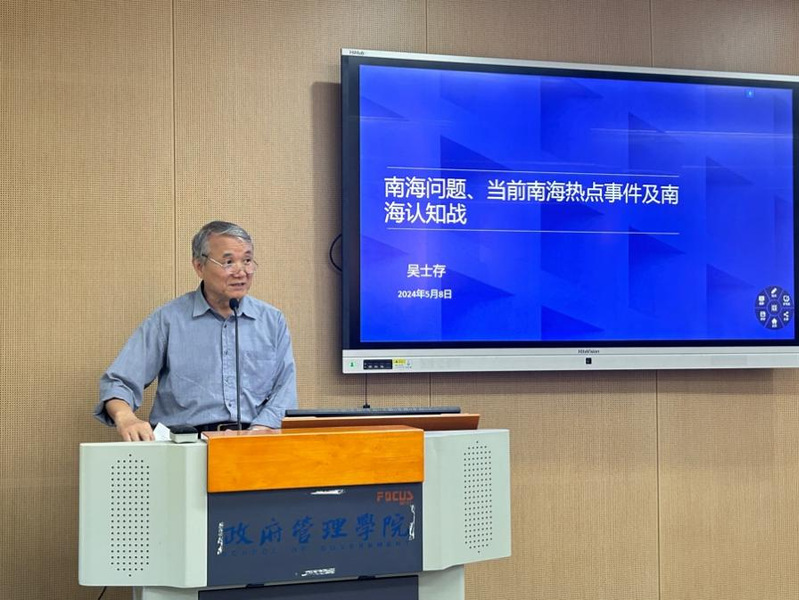
Professor Wu Shicun firstly introduced the basic situation of the South China Sea, then analyzed the causes of the South China Sea issue from geopolitics, nationalism, colonial history, great power hegemony, competition for resources, the United Nations Convention on the Law of the Sea, as well as internal factors. Then, he described the origin and development of the South China Sea issue in detail, and finally summed up the status quo and characteristics of the current situation of the South China Sea.
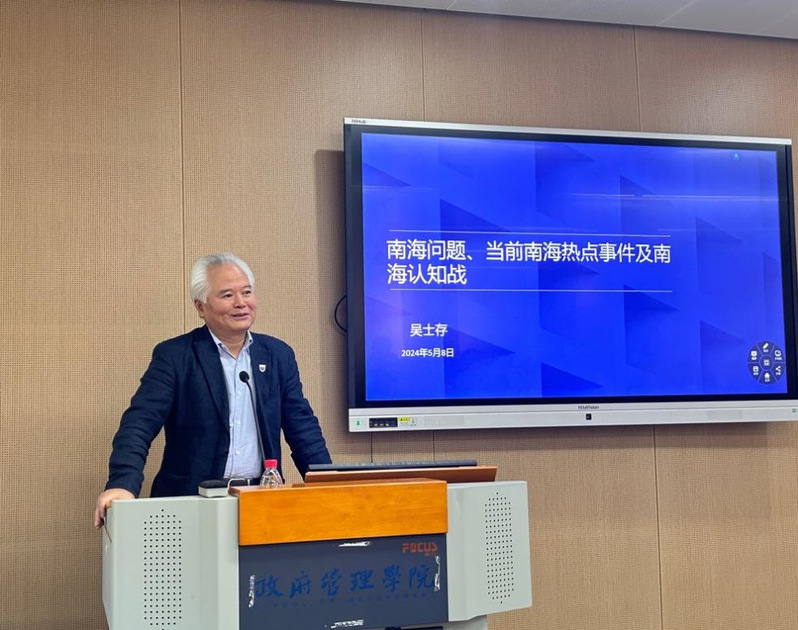
Professor Wu focused on analyzing the current hotspots of the South China Sea issue, such as the nine-dash line and the South China Sea Arbitration. He pointed out that the South China Sea Arbitration and its result have had a great negative impact on China’s claims in the South China Sea, almost completed denial of China’s claims in the South China Sea, and will continue to affect the development of the South China Sea issue in the future. He further suggested that in order to cope with possible crises and challenges, forces should be integrated at the national level to win the cognitive warfare in the South China Sea by means of information sharing and talent training.
The lecture attracted more than a hundred teachers and students from Nanjing University. At the end of the lecture, Professor Wu Shicun had a lively discussion with the teachers and students in attendance. The audience said that this lecture deepened their understanding of the South China Sea issue and international situation, and they look forward to more opportunities to participate in such lectures in the future. (Translate/Bao Yiwen)